 Skip to main content.
Press Release
Interview with Mr. Sàmper, Catalonia’s Minister of Business and Labour: Catalonia’s Roadmap to Global Leadership in Responsible AI
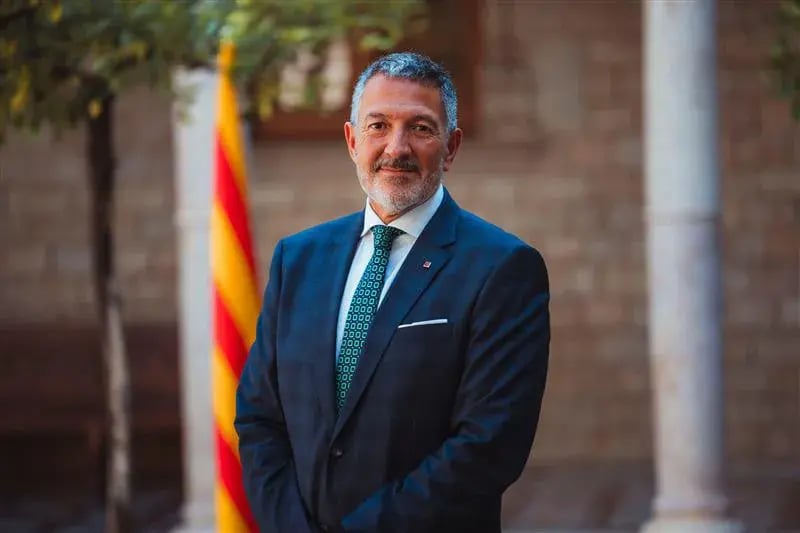
Thank you for joining us today, Mr. Sàmper. As Minister for Business and Labour, you have played a leading role in advancing the Government of Catalunya’s IA 2030 strategy, with a clear commitment to responsible innovation. What does this look like?
Thank you, it’s a pleasure to be here. Indeed, the Department of Business and Labour, which I have the honour to lead, has Digital Policies as one of its core responsibilities and fundamental pillars. This is why, through the Secretary for Digital Policies, we have taken the lead in driving this cross‑cutting strategy. As President Illa highlighted, the aim is clear: to strengthen competitiveness, improve quality of life and ensure shared prosperity through an artificial Intelligence that is responsible, ethical and secure.
And what this means is that we start with a clear conviction: technology must serve people, not the other way around. Artificial Intelligence has extraordinary potential to improve lives, from healthcare to sustainability, but only if ethics, transparency and inclusion are embedded from the very beginning.
The vision behind Catalunya’s AI 2030 strategy is to build an ecosystem where companies can innovate, talent can thrive, and society as a whole benefits from progress that is both responsible and scalable.
Thank you for sharing that vision. Stepping back, many say we are living through a historic shift. How do you see this moment?
We’re living in a moment of profound transformation. Artificial Intelligence is accelerating transformations across sectors at extraordinary speed - reshaping productivity, business models and the global economy. By 2030, advances in AI and information processing are expected to transform 86% of businesses worldwide. That scale of impact forces leaders to think beyond technology and consider ethics, trust, inclusion, and sustainability. This is where Europe is taking the lead.
And how is this global shift playing out locally? What’s the reality in Catalunya today?
Catalunya’s tech economy is on a steep growth curve. In 2024, more than 2,200 startups generated 2,340 million euros in revenue and created over 22,800 jobs with a 9% year‑on‑year surge.
Catalunya now hosts 203 international tech hubs, adding 4,100 million euros in annual impact and employing 46,080 professionals, cementing it’s position as one of Europe’s most dynamic innovation hubs. However, when you zoom out, the global AI race tells a very different story.
Right—the race feels very concentrated. Who’s really leading, and what does that mean for Europe?
Today, AI leadership is heavily concentrated in the United States and a handful of firms dominate the most advanced systems and cloud infrastructure. Meanwhile, Europe still imports much of the technology it consumes, and that level of dependence is far from ideal. Which is why Europe is taking a different path.
A different path… what does that look like?
It looks like the EU Artificial Intelligence Act. The world’s first comprehensive AI framework. It embeds human-centric, rights-protective, risk-based governance into a unified European market. In short, Europe is saying YES to innovation, but not at any cost. That philosophy sets us apart globally.
So we’re talking about very different models. How would you describe them?
Worldwide, three models coexist. Leading the way, we have the US model, that concentrates power in major tech platforms that accumulate vast amounts of data, wield significant influence and have the ability to shape the reality we perceive. The Chinese model integrates AI with state control and surveillance. Meanwhile, the European model puts innovation at the service of democracy and fundamental rights. It does this by banning unacceptable uses like social scoring, regulating high-risk applications with documentation and human oversight and setting obligations for general-purpose AI providers. Europe is betting on trust as its competitive edge and Catalunya is ready to lead the way.
Lead the way, how?
Through Catalunya’s AI 2030 strategy. It’s our roadmap to position AI as a strategic, ethical, and transformative asset for competitiveness and quality of life. It's composed of 8 strategic axes and 88 actions that are fully aligned with the EU AI Act. It’s about combining industrial scale with ethical leadership and those starts with clear principles.
So, what are those principles?
Ethics and democracy; transparency and continuous innovation; equity and inclusion; territorial cohesion and, of course, collaboration between the public and private sector, because leadership in AI requires joint effort from government, industry, and academia. But of course, those principles only matter as long as we translate into action.
So what does action look like?
Apart from mobilizing 1,000 million euros by 2030, it means helping SMEs adopt AI. It means transforming 200 public services so the public sector becomes a driver of innovation. Training 30,000 civil servants for responsible AI use and expanding talent pipelines with new degrees, masters, bootcamps and initiatives like ELLIS Barcelona.
And because infrastructure matters, we’re deploying a sovereign public cloud and federated data spaces for sectors like health, mobility and energy. This enable us to give companies secure and EU-compliant environments to build and scale. That’s how our vision becomes a reality.
That’s a big step toward sovereignty. Will these infrastructures also help smaller players like start-ups and SMEs?
Absolutely. The goal is to democratize access to advanced computing and trusted data environments. We are so lucky to count with the Barcelona Supercomputing Center and one of the European AI Factories here in Catalonia. By reducing dependency on non‑European platforms, we’re creating a level playing field where SMEs can innovate confidently, knowing they meet EU standards from day one and that’s what makes Catalunya attractive, not just for local entrepreneurs, but for global innovators.
Those are ambitious targets. Beyond strategy, what does the ecosystem look like today—and how would you quantify Catalunya’s hub potential?
Catalunya’s ecosystem isn’t just growing, it’s maturing and gaining global influence. Nearly half of local start-ups now surpass €500,000 in annual revenue, and international tech hubs here increasingly hold strategic mandates, not just delivery roles.
AI is becoming central to their portfolios, supported by a highly specialised scientific ecosystem. Currently there are 29 research centers working in advancing AI tech in close collaboration with start-ups, digital clusters and local talent. The Barcelona Supercomputing Center, the Center for Computer Vision, i2CAT, or the Institute for Robotics are some examples.
That’s impressive. And when we look closer, are these startups mainly local, or is international participation shaping the ecosystem?
It’s a mix, but the international footprint is growing fast. As mentioned, beyond startups, Catalunya hosts 203 international tech hubs, many of these aren’t just delivery centres, they actually hold global decision-making mandates.
So it’s not just quantity—it’s strategic influence. What about deep tech? Is AI really taking off?
Absolutely. On the deep‑tech front, we’ve seen explosive growth: 488 AI companies, up a 173% since 2019 and over 14,000 specialized jobs, supported by world-class institutions like the Barcelona Supercomputing Center (BSC), Centre de Visió per Computador (CVC), Eurecat, i2CAT, IIIA‑CSIC, and the ELLIS Unit Barcelona, among others.
And talent? Every global hub competes for it. How does Barcelona measure up?
Talent is one of the biggest challenges we encounter when facing AI market adoption. Catalonia accounted on over 172,000 ICT workers in 2025. ICT job growth is very focused in Barcelona and its metropolitan area. This is proof of our global attractiveness and strong talent pipelines.
Definitively, that’s a strong signal of global appeal. For someone visiting MWC, where can they actually see this innovation in action?
If you want a glimpse of Catalunya’s tech ecosystem in action, join us at the Catalonia Pavilion in Congress Square and in 4YFN and engage with some of the organizations providing cutting-edge solutions across strategic sectors such as health, manufacturing, mobility, and space.
Make sure to also step by Talent Arena. Last year we held the first edition, with over 20,000 attendees – such an impressive response. This year it‘s even bigger, many global companies will be present, and we expect to raise even more interest.
I’ll make sure to drop by. Now… innovation also raises big questions and AI is everywhere now. How do you make sure this transformation is built on trust and ethics?
For us, innovation isn’t enough, we need to set the rules of the game. That’s why Catalunya is leading the Manifesto for Advancing Trustworthy AI, a global commitment to make AI ethical, transparent and inclusive. For us it’s not a side project, it’s a core pillar.
So far 17 Governments from across the globe have signed up the Manifesto, from Massachussetts in the US, to Gyeonggy in South Korea.
That sounds like a strong commitment. Can you break it down for us, what does the manifesto actually stand for?
It’s about putting people at the center. The manifesto promotes an ethical governance to protect rights and democratic values and aims to ensures transparency and accountability. It also advocates for inclusivity and sustainability by reducing bias and minimizing its environmental impact while fostering collaboration between government, industry and academia to create a shared framework for responsible AI.
So ethics isn’t just a statement, it’s embedded in your strategy. How does this connect to Catalunya’s 2030 AI strategy?
It’s fully aligned with both our strategy, but also with the EU AI Act. Together, they ensure that as we mobilize 1,000 million euros and help SMEs adopt AI, we do so with guarantees, not just speed. We empower and educate our citizens to access the tools to both understand and use AI; We also use AI to improve public services in a transparent and trustworthy manner. Our vision is clear: technology must serve humanity, not the other way around.
You’ve emphasized responsibility and alignment with EU standards. Globally, we see similar efforts through initiatives like ITU’s AI for Good. Where does Catalunya fit into that movement?
We’re fully aligned with it, and we turn it into action. AI for Good isn’t just a slogan for us, it’s a roadmap. Catalunya works closely with ITU’s AI for Good, and we see how it truly contributes to deploy real projects that create positive impact, from emergency response systems to healthcare innovation. It’s about making sure AI improves lives, not just processes.
Give me an example—what does AI for Good look like on the ground?
One example is emergency response. AI helps predict natural disasters and supports real-time decision-making for services like 112 and Civil Protection. It’s about saving lives through data and foresight.
That sounds powerful. Are there other sectors where this vision is making a difference?
In healthcare, AI is improving diagnostics and operations, from imaging to triage to smart process automation, making patient journeys faster and reducing administrative burdens.
We are running an ITU’s AI for Good Innovation Factory Catalonia here at MWC. It is focused on solutions that use AI to improve health. And last year, the winner, a Catalan start-up called Predictheon made it to the grand finale at ITU’s AI for Good Global Summit.
And what makes these projects move from concept to reality?
It takes strong vision, alignment and instruments. The Center CIDAI acts as a public-private catalyst for pilots and adoption, turning ideas into implementation. OEIAC, our Ethics Observatory, ensures trust and accountability across AI projects. We also run an AI Accelerator to bring ideas into projects.
And what role does the public sector play in this transformation?
Twofold. On the one side, we act as a vision setter: our AI2030 Strategy aligns interests, and focuses efforts in a specific direction. On the other side, we act as catalysers: public sector projects in health, emergency, and connectivity act as tractors of demand, accelerating adoption and de-risking investment.
You’ve emphasized making AI serve people. Beyond public services, AI is also reshaping the workplace. How do you make sure people stay at the center of this transformation?
That’s an important question. Catalunya’s digital workforce is large and continues to grow. Nevertheless, we see a gap between the fast digital job generation and the talent that we currently have, can acquire or can form. Even though the big job creation in the sector in 2025, some studies indicate a gap on over 9,000 ICT jobs still vacant in Catalonia.
There’s clearly a gap between offer and demand of talent. AI is reshaping workplace and is displacing activities and jobs – even in the ICT sector. We are promoting a National Pact for Digital Talent, to ensue companies and the market meet the talent they need. And we’re focusing very much on lifelong reskilling.
And beyond skill, what about rights and protections for workers in this new AI-driven economy?
We advocate a renewed social contract for the digital age. Ensuring auditability, explainability, and human oversight, alongside privacy by design, clear limits on cyber surveillance, structured dialogue among platforms, unions, and employers, responsible remote work regulation, and the right to disconnect. Digital literacy programs are also key to empower workers and avoid asymmetries of power.
So this isn’t just about technology, it’s about trust and fairness too.
Exactly. These commitments align with the EU AI Act’s risk-based framework, reducing legal and reputational risk for companies while enabling scalable deployment. It’s about creating an environment where innovation and rights go hand in hand.
Building trust clearly matters for adoption. How do you translate that into an environment where both global companies and start-ups can grow and innovate?
By combining scale with responsibility. For global companies, Catalunya offers something unique: a strategic location within the EU, regulatory clarity under the AI Act and access to a deep talent pool. And it’s not just about delivery anymore, our international hubs increasingly hold global decision-making mandates, making Catalunya a true nerve center for innovation.
And what about start-ups? How do they fit into this picture?
Start-ups are at the heart of our ecosystem. We have more than 2,200 tech ventures, strong funding networks, and public-private platforms to accelerate adoption and de-risk investment. Under the Digital Catalonia Alliance (DCA) we connect with over 650 start-ups which we call Catalonia’s tech offer. We work with them so that they can design and offer solutions to the needs of our ecosystem, including industry and traditional sectors.
So companies can really test and scale here before going global?
Exactly. And beyond that, we encourage companies to invest in hubs that hold global decision-making mandates. Catalunya’s hubs increasingly sit at the strategic core of parent companies, not just as execution centers.
Scaling globally is exciting, but it comes with regulatory challenges. How do you support companies in meeting compliance from day one?
That’s why we embed Responsible AI from day one: map your use cases to EU AI Act risk categories, implement model governance and human oversight and communicate transparently with employees and regulators.
Time is running out... before we wrap up, what’s your closing message to MWC attendees?
The time to advocate for trustworthy AI is now. The direction AI takes is not inevitable—it is a choice. Today, we are witnessing developments that risk deepening social inequalities and amplifying existing harms. This places us at a critical intersection of technology, ethics, and social impact. AI is not merely a tool for efficiency; when guided by clear values and intent, it can become a powerful catalyst for progress—helping predict natural disasters, improve healthcare diagnostics, optimize energy consumption, and bridge gaps in education. The question is not whether we use AI, but how and for whom. Let’s choose to use AI for good—for everyone.
So Catalunya isn’t just following the trend, it’s shaping the future.
Absolutely. Catalunya is a hub for trustworthy AI and ethical innovation. If you resonate with our vision, come by our Pavilion and we’ll show you how we’re doing it.