 Skip to main content.
Blog
AI in Overalls: Scaling Intelligence Across the Industrial Value Chain
By Stéphane Sireau, Vice President High-Tech Industry, Dassault Systèmes
The phrase “AI at scale” is starting to lose meaning. Not because the ambition is wrong, but because the conversation is often trapped in abstractions: models, tokens, benchmarks, cloud capacity. Industry does not transform in abstractions. Industry transforms when intelligence shows up where value is created, where constraints are non-negotiable, and where decisions have immediate physical consequences. That is why I like the idea of “AI in overalls”, the name of the session that I’ll be participating at this year’s Mobile World Congress.
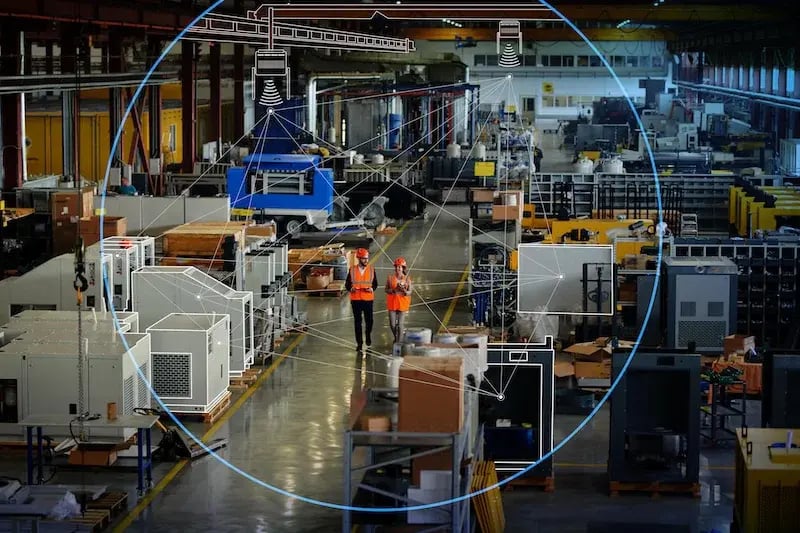
AI in overalls is a simple image for a complex shift: AI moving from analysis to action, from recommendation to execution, from digital workflows to real world operations. It is intelligence embedded in machines, in production lines, in logistics flows, and increasingly in collaborative robots that share space with people. It is also intelligence embedded in the infrastructure that connects it all: mobile networks, edge computing, cloud platforms, and the data foundations that turn signals into trusted decisions.
At MWC26 Barcelona, we are bringing this conversation to the Connected Industries space, because the future of industrial AI is inseparable from the future of connectivity. When low latency, high reliability networks meet virtual twins and embodied AI, industry gains something more powerful than automation: adaptive capability.
This article explores what it means to scale intelligence across the industrial value chain, why robotics is becoming the most visible frontier of AI, and how leaders can move from pilots to industrialization without compromising safety, sovereignty, or human purpose.
From insight to agency: the new shape of industrial AI
Industrial organizations are not short on data. They are short on usable understanding. A factory generates telemetry from machines, quality stations, energy systems, and material flows. An enterprise adds ERP transactions, supply chain events, engineering change orders, customer configurations, and service records. A network layer adds its own stream: device location, throughput, latency, and network conditions. The result is a flood of information, but too little shared meaning.
The first wave of industrial AI focused on pattern recognition: predicting failures, spotting anomalies, optimizing scheduling. Valuable, but limited. The second wave is shifting toward systems that reason and act in context, combining machine learning, symbolic and semantic techniques, and workflow automation. In practical terms, it means AI that can interpret intent, link cause and effect across domains, and propose actions that respect constraints.
The third wave is where the “overalls” metaphor becomes real: embodied AI. Intelligence that is not only observing industrial reality, but physically participating in it through robotics and autonomous systems. When AI becomes embodied, the challenges change dramatically:
- Decisions must be real time, not batch.
- Safety is a design principle, not a checklist at the end.
- Reliability is measured in uptime and throughput, not in model accuracy alone.
- Trust is earned through traceability and explainability, not by impressive demos.
This is where connectivity stops being a utility and becomes strategic. The industrial value chain is becoming a distributed system of intelligence, and distributed intelligence needs a nervous system.
Connectivity as the nervous system of autonomy
Autonomy depends on reliable connectivity, and connectivity reaches its value when paired with intelligence. Mobile technologies, including private 5G, advanced 4G, and emerging edge architectures, provide the characteristics industrial AI needs: deterministic performance, prioritization, scalability, and the ability to connect a heterogeneous ecosystem of assets. In the industrial world, the network is not simply a pipe for data. It is an active enabler of orchestration. Consider what changes when you can rely on consistent low latency and high reliability communications across a production environment:
- Vision systems can coordinate with robotic arms with tight timing constraints.
- Autonomous mobile robots can navigate dynamic shopfloors with fewer safety buffers.
- Remote experts can support maintenance with high fidelity video and sensor overlays.
- Inference can run at the edge while higher level context and learning remain in the cloud.
- Multi-site operations can standardize processes and improve resilience across global footprints.
This is not just about faster connectivity. It is about making industrial systems composable. Intelligence can be distributed across devices, edge nodes, and cloud services, while maintaining a coherent operational view. The industrial value chain begins to behave like a single adaptive organism.
But there is a catch. To scale, we need more than connectivity and more than AI. We need a shared reference of truth that bridges engineering, manufacturing, and operations. That is the role of virtual twins.
Virtual twins: the control tower for AI in overalls
Take the example of robots as advanced, autonomously operating cyber systems. They are impressive, but the real breakthrough is not the robot itself, but the system that makes it safe, efficient, and governable at scale. A virtual twin provides that system level perspective. It is a science based, continuously synchronized representation of products, processes, and operations. It connects what you design with what you produce and what you operate. It links behavior, constraints, and performance across the lifecycle. When you combine AI with virtual twins, several powerful capabilities emerge.
- Safer autonomy through virtual validation
Embodied AI learns. Learning in the physical world is expensive and risky. Virtual environments allow you to test behaviors, validate edge cases, simulate disruptions, and assess safety scenarios before deploying changes on the shopfloor. This is how you industrialize robotics without experimenting on live operations. - Better decisions through contextual intelligence
AI models are only as good as the context they can access. A virtual twin provides semantic structure: how assets relate, how processes flow, what constraints must be respected. It turns disconnected data into operational knowledge. That is a prerequisite for AI systems that can reason rather than merely correlate. - Continuous improvement, not one-off optimization
Industrial performance is not a single metric. It is a balance: throughput, quality, energy, safety, resilience, cost, and time to market. Virtual twins allow you to run continuous trade off analysis, explore scenarios, and align decisions across stakeholders. AI becomes a partner in that loop, not a black box generating isolated recommendations.
This is one reason we speak about virtual twin experiences on the 3DEXPERIENCE platform and, more broadly, 3D UNIV+RSES: environments where organizations can imagine, design, simulate, and operate complex systems with a coherent, governed data backbone. In a world racing to deploy AI, this matters because scale is not achieved by multiplying pilots. Scale is achieved by building a repeatable architecture for trust.
Robotics is not replacing humans, it is redefining work
Whenever robotics enters the conversation, two fears appear: replacement and dehumanization. Both are understandable, and both miss the more important point.
The industrial economy is facing a labor and skills reality: demographic pressure, safety expectations, rising complexity, and the need for sustainable operations. The question is not whether humans matter. The question is how we design industrial systems where humans can contribute at their best.
Intelligent robotics changes the human role from operator to supervisor, from repetitive task execution to exception handling, from manual adjustments to creative problem solving. In mature deployments, robots take on the tasks that are dull, dirty, dangerous, or ergonomically punishing. People take on the tasks that require judgement, improvisation, and responsibility.
The ‘dark factory’ idea is often misread. The objective is not to remove people, but to reduce hazardous exposure and eliminate avoidable friction, while elevating human work toward supervision, improvement, and innovation. The factory of the future should be illuminated by intelligence, not emptied of purpose. To achieve that outcome, leaders must treat human centric design as a system requirement:
- Skills development must be planned alongside automation roadmaps.
- Interfaces must be built for trust and comprehension, not for data volume.
- AI governance must include accountability and clear escalation paths.
- Safety must be engineered from the start, not audited at the end.
This is not a philosophical debate. It is the difference between robotics that scales and robotics that stalls.
The industrial value chain is converging, and AI exposes every seam
One of the biggest obstacles to scaling industrial AI is not the technology. It is the seams between functions: engineering to manufacturing, manufacturing to supply chain, operations to service, IT to OT, enterprise to partner ecosystem. AI makes these seams visible because it requires continuity. A robot learning a new motion path needs engineering intent, process constraints, and operational feedback. Predictive maintenance needs asset history, usage conditions, and maintenance actions. Energy optimization needs production plans, facility systems, and sustainability metrics. In other words, AI demands integration of the value chain.
This is why industry leaders are moving toward platform approaches that unify collaboration, data governance, and lifecycle continuity. It is also why telco and technology ecosystems matter. Industrial AI is increasingly a multi-party endeavor: manufacturers, network providers, cloud and edge infrastructure, robotics suppliers, software platforms, and integrators. Scaling intelligence is not only a technical program. It is an ecosystem capability.
How to move from pilots to scale: a practical path
If you are leading an industrial AI agenda, you have likely experienced the pattern: promising pilots that struggle to industrialize. The reasons are consistent. The following principles help break the cycle:
- Start with value chain use cases, not isolated tasks
Pick problems where cross functional continuity matters: quality loops between design and production, closed loop maintenance and operations, end to end traceability for regulated products, or energy and throughput optimization across sites. - Design for data integrity and semantics early
A model can be trained quickly. A trusted data foundation takes longer. Invest early in master data discipline, contextualization, and governance. Without semantic structure, AI is fragile. - Combine edge, cloud, and network intentionally
Decide what must happen at the edge for latency and resilience, what belongs in the cloud for scale and learning, and what depends on the network for orchestration. Avoid architectures that assume perfect connectivity or centralized control. - Use virtual twins to de-risk and accelerate
Virtual validation is not optional when physical systems are involved. Treat simulation and virtual commissioning as core to your AI and robotics deployment lifecycle. - Build governance that is operational, not theoretical
Define ownership, accountability, and change control. Ensure you can trace decisions, audit models, and manage updates safely. For embodied AI, governance and safety are inseparable. - Put people at the center of adoption
If operators and engineers do not trust the system, it will not scale. Invest in explainability, training, and redesigned workflows. The best AI is the one people want to use.
These steps are not glamorous, but they are what separates experimentation from transformation.
Why MWC matters for industrial AI
MWC26 Barcelona is often associated with consumer innovation. Increasingly, it is where the foundations of industrial innovation are shaped: networks, edge infrastructure, device ecosystems, and the software layers that turn connectivity into capability. Industrial AI will not be won by companies that only build better models. It will be won by companies that build better systems: connected, secure, governed, and human centric systems that can learn and adapt over time.
That is the opportunity in front of us. AI in overalls is not a slogan. It is a practical ambition: to embed intelligence across the industrial value chain, from design to operations, from the physical edge to the virtual twin, and from the network layer to business outcomes. At Dassault Systèmes, our focus is to help industrial innovators create virtual twin experiences that accelerate innovation while improving sustainability, resilience, and trust. At MWC26 Barcelona, we look forward to exchanging with manufacturers, technology providers, and operators on how to make this ambition real.
If you are attending MWC26 Barcelona, I invite you to join my session and continue the conversation at our stand. The next industrial decade will be defined by how well we connect intelligence to purpose, and how responsibly we bring it into the real world.