 Skip to main content.
Blog
Leading the future: intelligent, inclusive, unstoppable
By Vivek Badrinath, Director General, GSMA
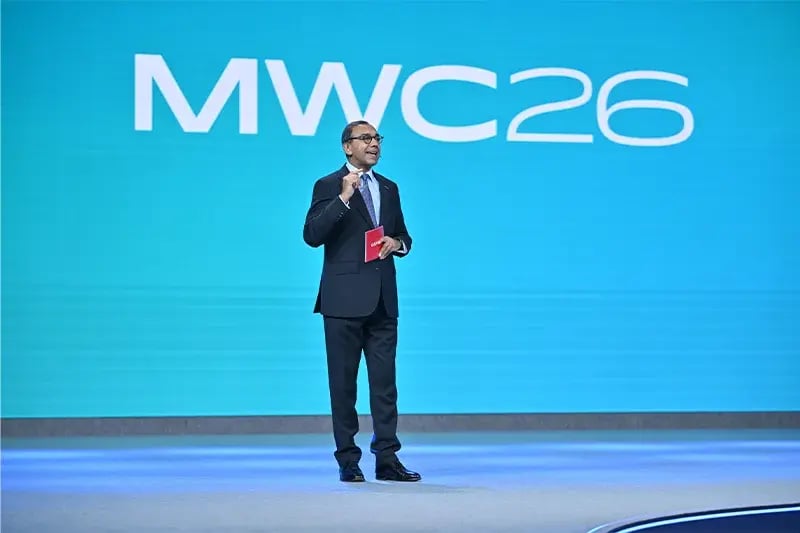
It was a great honour to open MWC26 Barcelona, my first as Director General of the GSMA. When you have a moment like this, you often find yourself looking back and it just so happens that next week we celebrate one hundred and fifty years since Alexander Graham Bell made the first phone call – the first step on a path that would lead us where we are today. One hundred and fifteen years later, the first GSM call was made in Europe built on what became a truly global standard that would unlock global scale and global innovation.
And this year we celebrate 20 years of MWC in wonderful Barcelona. Back then 3G had just launched, and the Motorola Razr V3 was the phone of the moment. Today there are almost 9 billion connections, and our industry connects 5.8 billion people - 70% of the world’s population. Last year we contributed $7.6 trillion, or 6.4% of global GDP and this will grow to over $11 trillion by 2030 as we contribute to an increasingly broad list of industries and sectors.
Over the last twenty years, the mobile industry has seen incredible growth. We became the nervous system of our digital world but today the landscape is changing. While anniversaries are an opportunity to marvel at the journey travelled, they are also an opportunity to look up and look ahead. As we do this, the next steps of the journey are clear and before us rise three mountains we must climb together.
First, we must complete the 5G journey. 5G is the modernisation of society itself. In a future where cities think for themselves, factories run autonomously, and robotics are part of daily life, investing in 5G standalone is essential and countries that hesitate will fall behind. In markets where adoption is at least 10%, operators are seeing double the revenue growth compared to those without it. 5G standalone could add up to $187 billion to mobile revenues by 2030. Just look at the US, China, and the Gulf States: they have ports, factories, hospitals – all running on 5G‑Advanced. These are not just proofs of concept, they are real-life operations and services in commercial use. But in Europe, we are losing ground. There is much more to be done to unlock the potential of 5G, in particular, slicing, to support these use cases.
Today, more than anything, the lack of scale is hindering operators from making the necessary investments. We welcome the Commission’s review of merger guidelines and have worked on concrete proposals to support this essential work. If we want to realise the full promise of 5G, and lay a healthy foundation for 6G, we must complete the 5G standalone journey.
Now, the second mountain we face is rising to the AI challenge. AI is transforming the world and the way we relate to it. And as telcos we have a crucial role to play because we are a foundational layer of the AI stack. Our infrastructure allows AI to run at the edge, in real time, for billions. As an industry we have embraced AI, and operators are investing at scale. From Deutsche Telekom’s €1‑billion AI factory, to China Mobile doubling its AI investment by 2028, to AT&T going all‑in on agentic AI. Indeed, there is incredible opportunity, but the research also shows that today’s AI models fall short of telco-specific needs. If we want to unlock the full benefits of AI for telco, we need telco-grade AI. We recently announced Open Telco AI, a new initiative where we will work with partners to:
- Launch a suite of open-telco models and datasets
- Open access to more compute for model training
- Benchmark progress through the Telco Capability Index
- And build community
But along with all this opportunity, we also have a responsibility. There are over 7,000 languages in the world, yet AI is trained in only a handful. A new AI language gap is emerging, on top of the gaps we already face – the coverage and the usage gap. If people cannot use AI in the language they speak, they are excluded from the opportunities it creates and the relevance of the models is vastly reduced.
Today, 300 million people are not yet covered by a mobile network and 3.1 billion people who live within coverage, are not using mobile internet for a variety of reasons. That means, 3.4 billion people are still not connected. Access to mobile money, precision agriculture, digital education and health services is already transforming millions of lives, now we must make them accessible to billions.
It’s crucial that we close these gaps and at the GSMA, we are working with partners to address challenges like handset affordability, digital skills and security. And of the 7,000 languages I mentioned, 2,000 are spoken in Africa so this is an exciting market to prove a new, open AI approach. We also recently launched the first Open Swahili Reasoning Model and I’m also pleased that 2 new compute providers have committed to support building a series open African-language models. The next AI breakthrough could come from anywhere but only if everyone is connected.
This brings me to our third mountain, as we continue forward in our journey, another reality becomes unavoidable: safety. Today, scammers are winning the arms race - using technology to stay ahead, exploit gaps between sectors and countries, and adapt. This global threat needs urgent, coordinated action. As an industry, we are collectively committed to fighting back. We’re investing in cutting edge defences, focusing on the safety and security of our handsets and networks and sharing intelligence with all digital partners to improve detection.
GSMA Open Gateway is a key tool here. The Scam Signal API, for instance, has improved scam detection rates by up to 40%, and is now being rolled out globally. Indeed, we will continue to do our part as an industry to address this challenge, but the reality is that the majority of scams happen beyond the control of operators. This is not a challenge that will be solved by one industry alone. We must all be united against scams – operators, security experts, ecosystem players, government and consumers – to build a safer digital future for us all. The journey that lies ahead won’t be easy. The challenges are massive, but the opportunities are exciting.
It’s clear we are in a new era, seamless interworking is confronted by the new, legitimate requirements of sovereignty, resilience, and protection. If we are to remain the nervous system, today, more than ever, we have a responsibility, to grow, to evolve, and to become the bridges between countries, industries and people. Because even as the global landscape shifts the world still needs a seamless connection.
And we can only deliver this if we preserve what has always powered our progress: global standards, global scale and global innovation. Our standards got us here - nobody wants to go back to the days where we had to change phones when we travelled. Our scale comes from our global market of almost 9 billion connections enabling us to scale up supply chains and bring down costs. And all of this drives global innovation, from the most sophisticated industrial 5G applications to funky video snippets to mobile money.
Global standards. Global scale. Global innovation. They brought us here and they will drive us forward, but we must work relentlessly to preserve them. If we achieve this, I believe we can ensure the best ideas, from everywhere, are the ones that shape a better future for us all.